



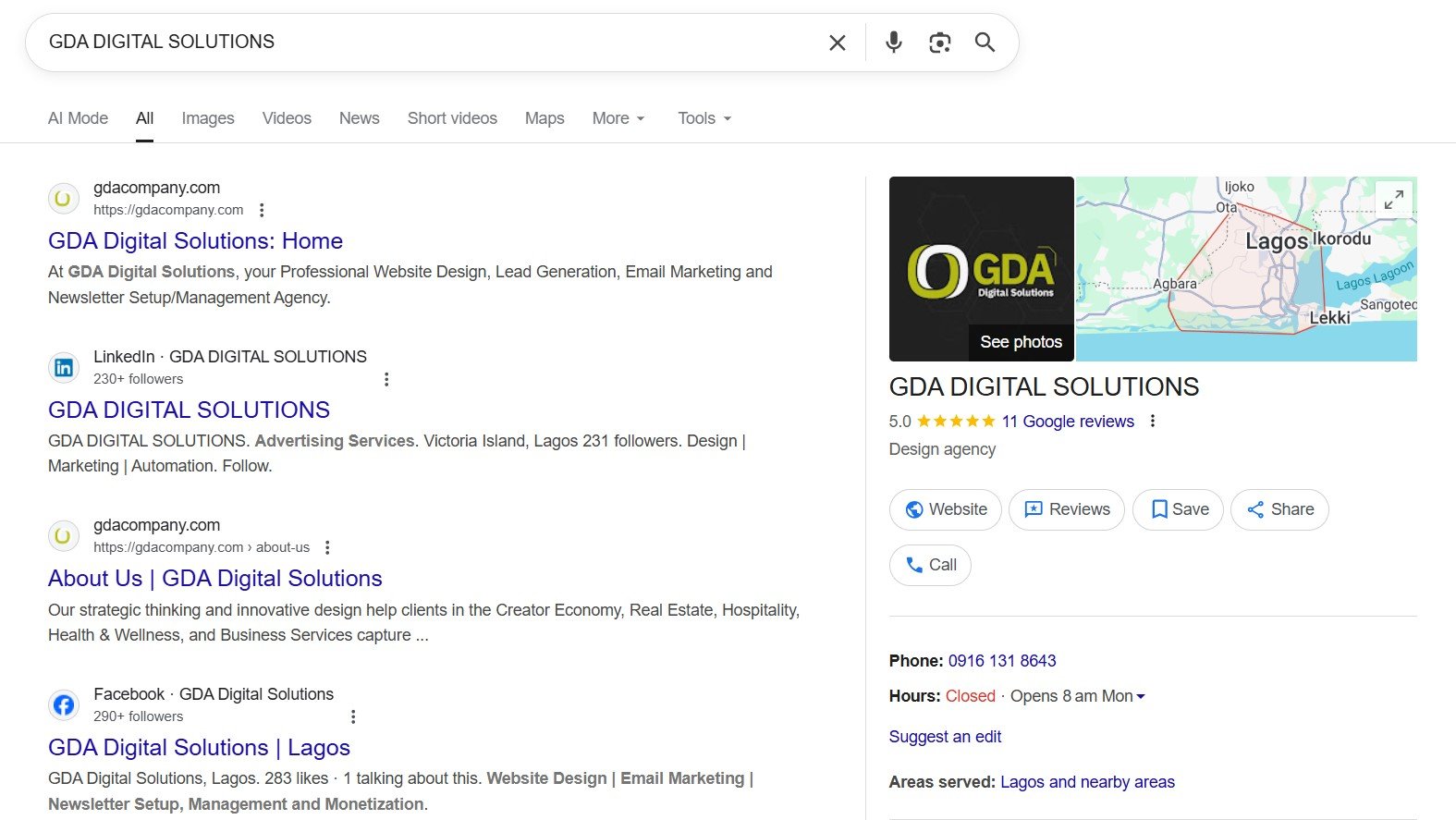
I had the privilege of being in a meeting with the owners of a small family-run business in Nigeria. They had arguably the best sourdough in the area, yet on any given Saturday, their shop was quiet while the mediocre café down the street had a line out the door. When we looked at their digital presence, the problem was obvious: they were virtually invisible to anyone searching online. They didn’t have a Google Business Profile, like this one in the image, and their address was listed differently on three separate websites.
We implemented a targeted strategy focused on local signals. Within four months, their organic traffic increased by 214%, but more importantly, their foot traffic doubled. This wasn’t magic; it was the result of answering a fundamental question: what is local SEO and how do we make it work for us?
If you are a business owner, founder, or marketing manager, you likely have a great product or service. Quality alone isn’t enough. You need to be found exactly when your potential customers are looking. What is local SEO? Simply put, it is the strategic process of optimizing your online presence to attract more business from relevant local searches. By the end of this guide, you will have a clear roadmap to rank in the “Local Pack” and turn casual searchers into loyal customers.
What Is Local SEO? A Simple Definition
To truly understand this concept, we must go beyond the basic definition. What is local SEO in the context of a modern digital marketing strategy? It is a highly specific branch of search engine optimization that helps your business be more visible in local search results on Google.
While traditional SEO focuses on improving your site’s visibility on a global or national scale, local SEO targets “near me” and geo-specific search queries. The intent is almost always transactional.
Consider the difference between these two searches:
- Traditional SEO: A user searches for “how to fix a leaking tap.” They are looking for information and might click on a blog post from a DIY site in another country.
- Local SEO: A user searches for “plumber in Lagos” or “emergency plumber near me.” This user has an immediate problem and is looking for a local service provider to hire right now.
When you ask what is local SEO, you are really asking how to get your business into the “Local Pack” (also known as the Map Pack or Snack Pack). This is the block of three business listings that appears below the map in a Google search result. It is the most valuable real estate on the search results page because it appears before the standard organic links. Dominating this space is the primary goal of any local search campaign.
The 3 Pillars on How Google’s Local Algorithm Works
Understanding what is local SEO requires a look under the hood of Google’s algorithm. Google uses a different set of ranking signals for local searches compared to standard organic searches. To rank your business, you must optimize for three core pillars: Relevance, Distance, and Prominence.
1. Relevance
Relevance refers to how well a local business profile matches what someone is searching for. If a user searches for “Italian restaurant,” Google will not show them a listing for a dry cleaner, even if the dry cleaner is next door. This is why selecting the correct primary and secondary categories on your Google Business Profile is critical. It helps the search engine understand your business “entity” and match it to user intent.
2. Distance (Proximity)
This factor is straightforward: how far is each potential search result from the location term used in the search? If a user doesn’t specify a location (e.g., just searching “coffee shop”), Google will calculate distance based on what is known about their location. While you cannot control where a user is standing when they search, you can control your defined service areas and ensure your address is accurate.
3. Prominence
Prominence refers to how well-known a business is. This is where your off-page SEO efforts come into play. Google looks at information from across the web – such as links, articles, and directories. More importantly, Google review count and review score are heavily weighted here. A business with 200 five-star reviews is likely to rank higher than a business with two reviews, assuming relevance and distance are comparable.
Why Local SEO Matters: Statistics You Can’t Ignore
If you are still wondering what is local SEO going to do for your bottom line, the data is undeniable. Consumer behavior has shifted permanently toward mobile-first, local discovery.
Here are the statistics that drive our agency’s strategy:
- 46% of all Google searches have “local intent.” This means nearly half of all activity on Google is people looking for local information.
- 76% of people who search on their smartphones for something nearby visit a business within 24 hours.
- 28% of those searches result in a purchase.
- Zero-Click Searches are rising: A significant number of users find the information they need (phone number, address, hours) directly on the Map Pack without ever clicking through to a website. If you aren’t in the Map Pack, you don’t exist to these users.
When we analyze these numbers, the answer to what is local SEO becomes clear: it is the most efficient way to capture high-intent traffic that is ready to buy.
Top Local SEO Ranking Factors for 2026
To rank #1, you need to prioritize the signals that move the needle. Based on the latest algorithm updates and extensive testing, here are the most critical ranking factors for 2025.
1. Google Business Profile (GBP) Optimization
Your Google Business Profile (formerly Google My Business) is the single most important asset. It is not just a listing; it is your interactive storefront. Completeness matters. Profiles with photos, services, hours, and attributes filled out rank significantly better.
2. NAP Consistency
NAP stands for Name, Address, and Phone number. Google relies on data consistency to verify that your business is legitimate. If your website lists your address as “123 Main St.” but your Facebook page says “123 Main Street, Suite 4,” this discrepancy can confuse the algorithm and lower your trust score.
3. Review Signals
It is not just about the number of stars. Google analyzes:
- Review Quantity: The total number of reviews.
- Review Velocity: The rate at which new reviews are posted. A sudden spike might look suspicious; a steady stream looks natural.
- Review Diversity: Do reviews contain keywords and photos?
- Owner Responses: Replying to reviews signals to Google (and customers) that you are active and engaged.
4. Local Citations
Citations are mentions of your business on other websites, usually directories like Yelp, Yellow Pages, TripAdvisor, or local chambers of commerce. These act as “votes of confidence” for your business’s existence and location.
5 Steps on How to Optimize Your Local SEO
Now that we have defined what is local SEO and why it matters, let’s look at the execution. Here is the exact 5-step strategy we use to help clients dominate their local market.
1: Audit Your NAP
Before building new signals, fix the old ones. Search your business name on Google and ensure your Name, Address, and Phone number are identical across your website, social media, and major directories. Even small variations can dilute your authority.
2: Master Your Google Business Profile
Claim and verify your profile. Then, go beyond the basics:
- Categories: Choose the most specific primary category available. If you are a pizza place, choose “Pizza Restaurant,” not just “Restaurant.”
- Photos: Upload high-quality photos of your team, your office, or your work. Geotagging photos (adding location metadata) can also provide a minor signal boost.
- Q&A: Pre-populate the Q&A section with common questions and answers to help voice search users.
3: Get More Reviews (Ethically)
You need a system. Do not buy reviews – this will get you banned. Instead, integrate review requests into your customer journey. Send an SMS or email immediately after a service is completed. Mentioning what is local SEO to your staff can help them understand why asking for that review is so crucial to the business’s growth.
4: Create Local Content
Google wants to see that you are truly part of the community. Create blog posts about local news, sponsor local events, or write “Best of [City]” guides. For example, a real estate agent could write a guide on “The Best Schools in [Neighborhood].” This signals strong local relevance.
5: Build Local Backlinks
Backlinks from high-authority sites are great, but for local SEO, relevance beats authority. A link from a local church, a neighborhood blog, or a fellow local business partner is incredibly valuable. It proves to Google that you are a trusted entity within that specific geographic network.
3 Local SEO Mistakes That Kill Rankings
Understanding what is local SEO also means knowing what not to do. Avoid these common pitfalls:
- Keyword Stuffing the Business Name: If your legal business name is “Smith Plumbing,” do not list yourself as “Smith Plumbing – Best Cheap Plumber in Chicago.” This is a violation of Google’s guidelines and is the fastest way to get your listing suspended.
- Ignoring Negative Reviews: A negative review is an opportunity. Responding professionally shows potential customers that you care about service recovery. ignoring them signals apathy.
- Inconsistent Hours: If Google says you are open but a customer arrives and you are closed, they will suggest an edit to your listing. If Google receives enough user edits, they may mark your business as unreliable.
Conclusion: Ready to Dominate Your Local Market?
We have covered the definition, the data, and the strategy. You now know what is local SEO – it is the bridge between your business and the customers right in your neighborhood who are looking for you. It is not about tricking the algorithm; it is about providing clear, consistent, and trusted signals to Google that you are the best answer for a local query.
The businesses that succeed in 2025 will be the ones that treat their local digital presence with the same care as their physical storefront. Start by auditing your Google Business Profile today. Sign up to our newsletter to receive updates straight into your inbox.
Frequently Asked Questions About Local SEO
What is local SEO and how does it differ from organic SEO?
It focuses specifically on optimizing a business’s online presence to be found by users in a specific geographic area (e.g., the Map Pack). Organic SEO focuses on ranking websites for general keywords globally or nationally.
How long does it take to see results from Local SEO?
While some changes (like updating business hours) are immediate, moving up the rankings typically takes 3 – 6 months. It depends on the competitiveness of your market and your starting baseline.
Can I do Local SEO without a physical address?
Yes. If you operate a Service Area Business (SAB) like a plumber or electrician who visits clients, you can hide your address on your Google Business Profile and set a “service area” instead.
Do online reviews really affect my ranking?
Yes, significantly. Reviews are a top-three ranking factor for the Prominence pillar of the local algorithm. They also heavily influence click-through rates.
Is Google Business Profile free?
Yes, creating and managing a Google Business Profile is 100% free. Be wary of agencies that claim you must pay Google to “keep” your listing.