

I’ll never forget a new client who came to our office with a 50,000-person email list and zero sales from it. They were “doing email marketing” every week, blasting promotional flyers to their entire list. Their problem? They had a list, but no relationship. They were talking at their audience, not with them.
This is the single most common mistake I see businesses make. They confuse “sending emails” with “email marketing.” One is a task; the other is a powerful revenue-generation system.
The data doesn’t lie. With an average return on investment (ROI) of $36 for every $1 spent, email marketing remains the most profitable and direct line of communication you have with your customers. It’s the #1 channel for lead nurturing and building long-term customer value.
By building a true strategy for that client – one focused on segmentation, value driven content, and automation – we (GDA Digital Solutions) helped them generate their first $10,000 in email-driven revenue in 90 days. This post is that strategy. This is our agency’s 10-step blueprint to stop blasting and start building a predictable profit engine.
What Is an Email Marketing Strategy? (And Why You’re Losing Money Without One)
Let’s be clear: An email marketing strategy is not just a plan to send a monthly newsletter or a few promotional emails.
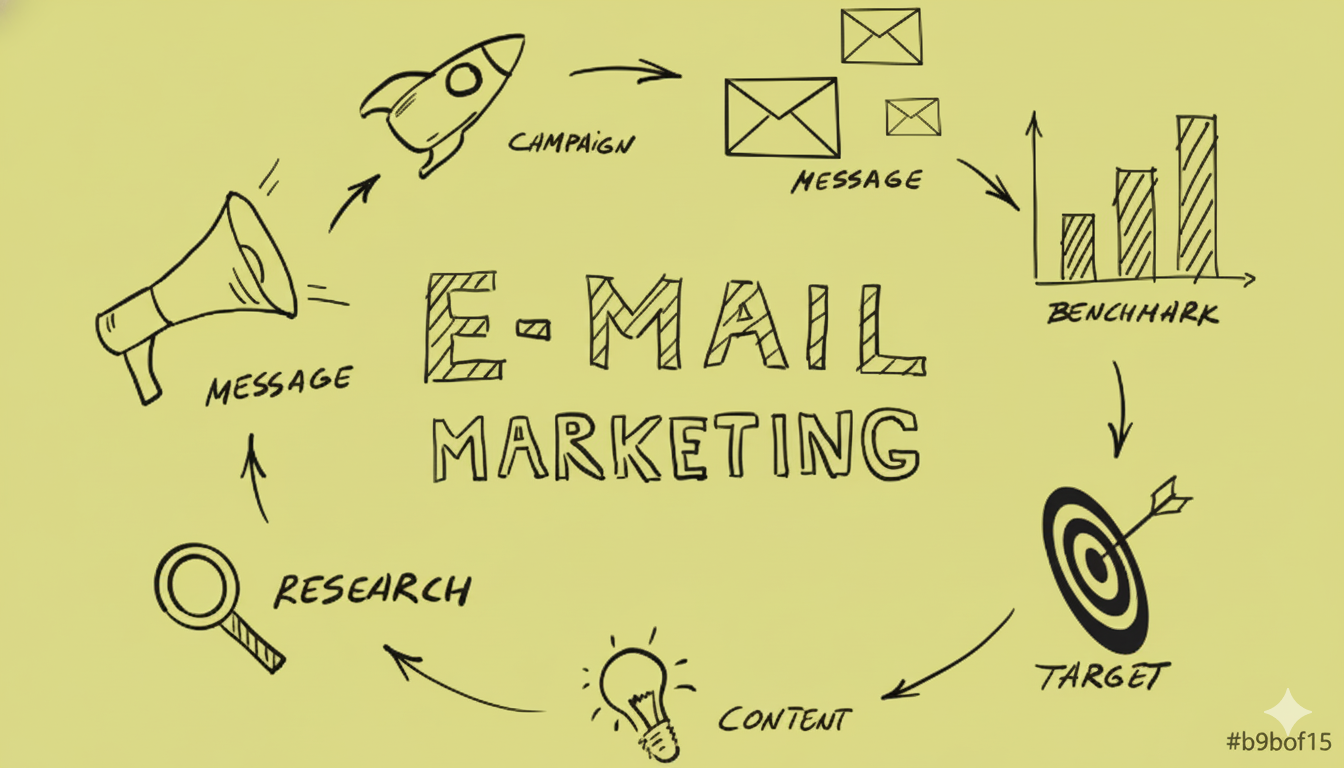
A successful email marketing strategy is a clear plan that uses email to build relationships with your target audience and guide them through the customer journey. It is the “why” behind every single email you send.
Here’s the difference, and it’s crucial:
- Tactic: Sending a 10% off email campaign to your entire list.
- Strategy: Creating an automated welcome series that first delivers a free guide, then shares a case study, and then offers a 10% discount on the third email to drive a conversion.
One is a hopeful shot in the dark. The other is a deliberate, relationship-building process. Without this plan, you’re not just leaving money on the table; you’re actively annoying your subscribers and burning out your list.
10-Step Blueprint for Your 2026 Email Strategy
Here is the exact 10-step framework I use to build profitable email marketing plans for our clients.
1. Define Your “Why” – Setting SMART Email Marketing Goals
Your email marketing strategy must be an extension of your primary business goals. Before you write a single subject line, you must define what success looks like. I use the SMART framework:
- Specific
- Measurable
- Achievable
- Relevant
- Time-bound
Your email marketing objectives are your guiding star. Everything else flows from them.
- Bad Goal: “I want to make more sales.”
- Good Goal: “I will increase our e-commerce conversion rate from email by 15% in Q1 by implementing an abandoned cart sequence.”
- Bad Goal: “I need to get more subscribers.”
- Good Goal: “I will grow our qualified subscriber list by 500 new leads per month by promoting our new webinar lead magnet.”
2. Know Your Audience (The Core of Your Email Strategy)
You cannot have a relevant conversation if you don’t know who you’re talking to. Blasting one message to everyone is the fastest way to the spam folder.
You must develop 1-2 core buyer personas. This isn’t just demographics like “Marketing Manager, 35-45.” It’s about their pain points.
- What problem do they have that you solve?
- Why did they subscribe? What do they hope to learn?
- What topics do they crave, and what topics bore them?
If you don’t know the answers, you can’t personalize. And if you can’t personalize, your email marketing strategy will fail. Yes! I mean it and that’s the fact.
3. Master Email List Building (The Right Way)
Your email list is your single greatest digital asset. It’s the one audience you truly own, safe from algorithm changes on social media. Building it correctly is essential.
I always tell my clients that a small, engaged list of 1,000 true fans is infinitely more valuable than a 50,000-person list of unengaged contacts.
Why You MUST Use a Double Opt-In
A double opt-in requires a new subscriber to confirm their email address via a follow-up email. In my opinion, this is non-negotiable. It builds trust and is the basics of having a good list building system. It ensures you have a high-quality list of people who want to hear from you, which dramatically improves your email deliverability.
3 High-Converting Lead Magnets
A lead magnet is the ethical bribe you offer in exchange for an email address.
- Checklists/Cheatsheets: High-value, easily digestible, and position you as a problem-solver.
- Webinars/Workshops: My personal favorite. This builds massive Expertise and Authoritativeness and attracts highly qualified leads.
- Exclusive Discounts/Early Access: A powerful incentive for e-commerce and product-based businesses.
Where to Place Your Sign-up Forms
Your sign-up forms should be easy to find. Place them on your website header, in your blog post footers, on your “About” page, and consider a well-timed exit-intent pop-up.
4. The 760% Revenue Secret: Your Email Segmentation Strategy
If you do only one thing from this guide, do this. This is the most critical part of any modern email marketing strategy.
Marketers who used list segmentation saw as much as a 760% increase in revenue.
Why? Because it’s the engine of relevance. Segmentation is the practice of dividing your list into smaller groups (segments) based on specific criteria, so you can send them highly relevant content.
4 Simple Ways to Segment Your List Today
- Demographics: (e.g., B2B vs. B2C, job title, location).
- Sign-up Source: (e.g., “Webinar” leads vs. “Checklist” leads). These groups have different needs.
- Behavioral Segmentation: This is the most powerful. You can create segments based on user actions: “Active Fans” (opened an email in 30 days), “Dormant Subscribers” (no open in 90 days), or “Clicked on Product X.”
- Purchase History: (e.g., “New Customers” vs. “VIPs” vs. “No Purchase Yet”). You would never speak to a first-time buyer the same way you speak to a loyal brand advocate.
5. How Email Personalization Drives Clicks (Beyond [First Name])
Personalization is the result of good segmentation. And it works. Studies show that personalized calls-to-action (CTAs) can convert 202% better than generic ones.
This goes far beyond using merge tags to insert a first name. True personalization is about sending relevant content.
Thanks to segmentation, you can use dynamic content. This allows you to build one email template, but show different content blocks to different segments. For example, a clothing store can send one email that shows womenswear to its female segment and menswear to its male segment.
6. Plan Your Content: The 80/20 Value-First Email Campaign Strategy
Here is a rule I do implement: The 80/20 Rule of Email.
Your content strategy should be: 80% value, 20% promotion.
80% of your emails should be educational, entertaining, or helpful. They should build Trust, Expertise and Confidence. Only 20% of your emails should be direct promotional emails asking for a sale.
This simple content strategy does something magical: it trains your audience to open your emails. They know they will get value, not just a sales pitch. When you do send a promotion, they are far more likely to act. Your email newsletter should be something your audience looks forward to.
7. The 320% Revenue Multiplier: Must-Have Email Automation Workflows
This is how you scale your relationships and your email marketing strategy. Email automation (or a drip campaign) is a series of emails sent automatically based on a specific trigger.
Automated emails are powerful, generating 320% more revenue than non-automated email campaigns.
Automation 1: The Welcome Email Series
A new subscriber is at their highest point of engagement. A welcome series has an average open rate of 68.6%. This is your “first date.” Use a 3-5 email automated workflow to deliver your lead magnet, introduce your brand story, and build trust.
Automation 2: The Abandoned Cart Recovery Flow
For any e-commerce business, this is a must. This automation automatically emails a customer who added items to their cart but didn’t check out. It’s one of the highest-ROI automations you can build.
Automation 3: The Re-engagement Campaign
You will always have dormant subscribers. A re-engagement campaign automatically targets subscribers who haven’t opened an email in (for example) 90 days. It sends a simple “Are we breaking up?” email with a special incentive or a poll, giving you one last chance to win them back.
8. Design for Thumbs: Mobile-First Responsive Design
This is a quick but critical step. Over 50% of people will delete an email if it isn’t a mobile-friendly email (Litmus, 2023).
Your email design must be responsive. This means it looks great on all devices. My simple rules are:
- Use a single-column layout.
- Use large, readable fonts (16px+ for body text).
- Make your call-to-action (CTA) buttons large, high-contrast, and “thumb-friendly.”
- Keep subject lines under 50 characters to avoid being cut off.
9. How to Improve Email Deliverability (And Land in the Inbox)
Your email marketing strategy is useless if your emails go to the spam filter. This is your Trustworthiness pillar.
Email deliverability – the ability to land in the inbox – depends on your sender reputation.
Your Legal Obligations: CAN-SPAM and GDPR
This is non-negotiable. To be compliant and protect your reputation, you must:
- Have explicit permission to email someone (via double opt-in).
- Include your physical business address in every email.
- Provide a clear, one-click unsubscribe link in every email.
The ‘Big 3’ of Authentication: SPF, DKIM, & DMARC
This sounds technical, but it’s simple. Think of SPF, DKIM, and DMARC as your domain’s “digital passport.” They are simple records you add to your website’s settings.
They prove to Google and Microsoft that your email service provider (like MailerLite or Klaviyo) has permission to send emails on your behalf. Without them, you look suspicious, and your deliverability will suffer.
10. Measure Your Email Marketing KPIs (Test, Optimize, Repeat)
Finally, your email marketing strategy must be data-driven. You don’t “set it and forget it.” You test, optimize, and improve.
How to Use A/B Testing to Get Better Results
A/B testing (or split testing) is sending two variations of an email to a small part of your list to see which performs better. The #1 thing to test is your subject line. You can also test your CTA text, send time, or images. The rule: only test one variable at a time.
The 4 Email Marketing KPIs That Actually Matter
In 2025, open rates are no longer a reliable metric of success. Due to Apple’s Mail Privacy Protection (MPP), many emails are marked “opened” even if the user never saw them.
Instead, I focus on these email marketing KPIs:
- Click-Through Rate (CTR): The true measure of engagement. What percentage of people clicked a link in your email? This is your most important metric.
- Conversion Rate: What percentage of clickers took your desired action (e.g., bought, downloaded, signed up)? This measures ROI.
- Unsubscribe Rate: A high rate (over 0.5%) is a red flag that your content is not matching audience expectations.
- List Growth Rate: Are you adding more new subscribers than you are losing?
Choosing the Right Email Service Provider (ESP): Our Expert-Vetted Toolkit
As an agency, I’ve used dozens of email marketing platforms. The tool is less important than the strategy, but a good tool makes the strategy possible.
- For E-commerce: I recommend Klaviyo or Omnisend. They are built for e-commerce segmentation and abandoned cart flows.
- For B2B/Creators: I recommend ActiveCampaign or ConvertKit. They have powerful email automation workflows and lead nurturing capabilities.
- For Beginners/Small Biz: I recommend MailerLite or Brevo (formerly Sendinblue). They are easy to use, affordable, and have excellent deliverability.
Conclusion
A successful email marketing strategy is not a one-time task. It is an ongoing process of listening to your audience, providing immense value, and building a genuine relationship.
This 10-step blueprint is your framework. It moves you from “blasting” to “building.” When you focus on your email marketing goals, segment your audience, and provide value through automation, your email list will transform from a simple list of contacts into your business’s most valuable, predictable, and profitable asset.
Frequently Asked Questions
What is an email marketing strategy?
An email marketing strategy is a comprehensive plan that outlines your goals and the actions you’ll take to achieve them using email. It goes beyond just sending promotional emails. It includes who you’re targeting (buyer personas), how you’ll get them on your list (lead magnets), what you’ll send them (content strategy), how you’ll group them (segmentation), and how you’ll measure success (KPIs).
What is the first step in creating an email marketing strategy?
The first and most important step is defining your goals. Without clear email marketing goals (e.g., “increase conversion rate by 15%,” “grow our list by 500 leads/month”), you have no way to measure your ROI. Your goals will determine your target audience, your lead magnets, and your content strategy.
How often should I send marketing emails?
This depends entirely on your audience, industry, and content. The best answer is to “send as often as you can provide value.” For an email newsletter, this might be weekly. For a B2B lead nurturing flow, it might be every few days. The key is consistency and adhering to the 80/20 rule (80% value, 20% promotion).
What are the most important email marketing KPIs to track?
While open rates are a common metric, they are less reliable due to privacy changes. The most important email marketing KPIs for measuring success are:
- Click-Through Rate (CTR): Shows how many people engaged with your content.
- Conversion Rate: Shows how many people took your desired action (e.g., made a purchase).
- Unsubscribe Rate: Shows if your content is relevant.
- List Growth Rate: Shows if your lead magnets are effective.
What is the average ROI of an email marketing strategy?
Email marketing consistently delivers the highest return on investment (ROI) of any digital marketing channel. While this varies by industry, recent data shows the average ROI is $36 for every $1 spent. This high ROI is why having a powerful email marketing strategy is essential for any business.
If you found this guide helpful, you’ll love the exclusive tips and case studies I share with my subscribers. To get our agency’s expert marketing insights delivered straight to your inbox, sign up for our newsletter.